
How to Renovate Your Existing Bathroom to Make It Accessible
Transforming Your Bathroom for Accessibility
With a wealth of experience in accessible design, we at Himmelzimmer created this article for anyone embarking on making their bathroom accessible yet aesthetically pleasing.
At the outset of your journey into making these changes, we recommend seeking assistance from himmelzimmer or other design professionals who can plan, design and project manage the changes to your home to deliver the best outcome for you, whether you’re undertaking this project to improve comfort or due to recommendations from an occupational therapist / physiotherapist.
We view this as an opportunity to improve and rethink the bathroom with new materials, fixtures, and fittings that are accessible, and the possibilities can surprise you with their minimal elegance as well as their down-to-earth practicality.
A Personal Journey
When Chris’s Aunt slipped and fell while getting out of the shower last year, she wasn’t badly hurt but was shaken by the incident.
Family conversations shifted from holiday plans to grab rails and walk-in showers. When he spoke about making her bathroom more accessible, my aunt was horrified at the thought of her beautiful bathroom being turned into what she called “a faceless hospital toilet.”
We understood her resistance. At 75, she’s fiercely independent and takes enormous pride in her home. The idea of installing clinical white fixtures with no visual appeal, felt like giving up on her dream of a considered and contemporary designed home. How ever taking no action wasn’t an option either.
With our background in healthcare architecture and wheelchair accessible design, we knew it was possible to create a bathroom that’s safer and more accessible without sacrificing elegance or style.
If you, or a parent or elderly relative, might be in a similar situation, we’ve compiled a selection of tips and observations from our research and experience that will start you on the journey of designing your own accessible bathroom that makes life easier, more comfortable and still looks stylish.
Starting the Conversation
Whether you are the one needing changes or suggesting them to a parent, these conversations touch on the sensitive subjects of aging and independence. The NHS advises that one in three people over 65 will fall each year. After the stairs, the bathroom is the most common place for falls, and we are writing to confirm that the solution - renovation for accessibility improvements - does not have to look drastically plain.
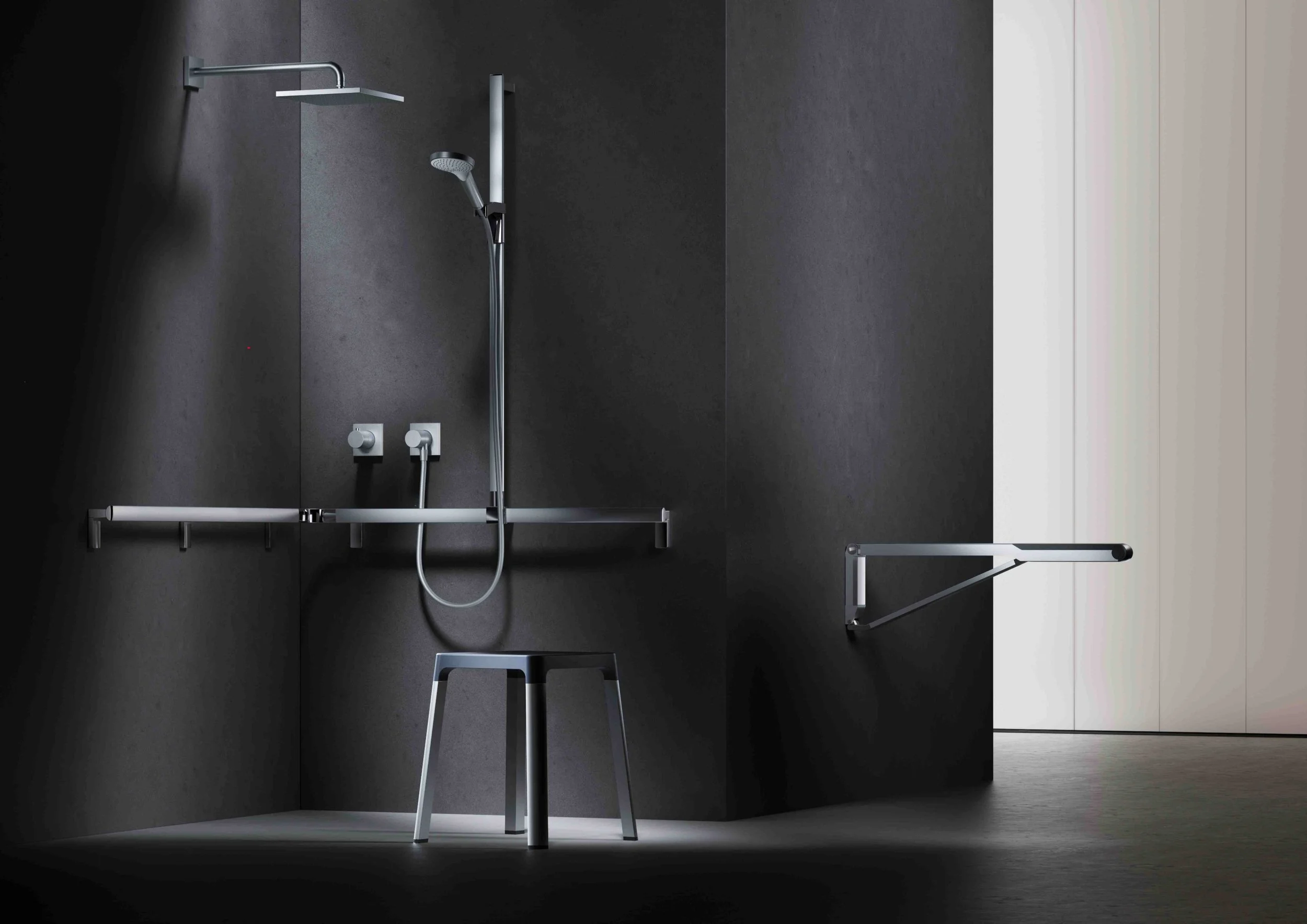
Accessible bathrooms will have multiple safety devices that ensure safe navigation and use of the space. Image courtesy of Keuco gmbh
Circulation and Flow
Accessible bathrooms should ideally be situated on the same floor as the principal bedroom. This is important for dignity and ease of use at nighttime.
Clear access zones need to be provided for each bathroom fitting so that a wheelchair or ambulant user can get to and from them comfortably. Most bathrooms are designed with a minimal footprint to save space. This can be overcome by good interior planning to create wider spaces for circulation. The benefits of undertaking bathroom renovations of this nature are that accessible design makes everyday tasks such as brushing your teeth or bathing more manageable and comfortable for all.
For reference, for a truly accessible future-proof toilet, you must have a turning circle that is ideally 1500mm x 1500mm - about 5 feet in each direction - to allow comfortable wheelchair manoeuvrability if ever needed.
We widened my aunt’s bathroom doorway during renovation. The door now has a sleek pocket design that slides into the wall and has an integrated acoustic rating, which works well in tight spaces and looks more modern than the old, hinged door while providing much better
access. We opted for a 1,000mm clear opening to ensure suitability should she ever need to utilise a wheelchair. Whilst not necessary now, this generosity makes everyday life easier in navigating the bathroom space.
One clever detail we opted for: we installed a flip-over lock that can be operated from both sides. It gives privacy but means if she fell and could not reach the door, we could get in to help.
Textures and Finishes

The material moodboard: Acceesibility and aesthetics are not mutually exclusive and moodboards are instrumental in understanding the interplay between various finishes and fixtures and the overall look.
Textures and finishes can make a massive impact on a bathroom being renovated. It’s an opportunity for revitalizing this space with significant impact on the wellbeing of the user as well as the aesthetic of the space.
Think of light or pastel colours to make the space feel generous, and a pop of bright warm colours can give a mental boost. Earthy colours can be healing and calming when thoughtfully used. Moving away from stark or sterile colour and material palettes is advisable to promote relaxation and connect the space to your home rather than make it seem clinical.
Wall finishes are advised to allow for the furniture and fittings to stand out so they contrast well. Ensure room for contrast between finishes as this is important for wayfinding. For example, black metal grab rails set against light grey wall tiles ensure high visibility.
The warmth and character of a home can continue in its bathroom with materials such as timber, metals like bronze and copper, and natural fabrics that are carefully positioned and specified to deal with the damp environment.
Make sure the continuity of the original concept is carried through when choosing textures, finishes, fixtures, and fittings, as more accessible products are coming to market that offer a huge increase in alternatives.
Colours and Contrast
Strong colour contrast is required for depth perception and identifying different elements, which becomes more important as vision changes with age.
The toilet and sink are white, which stands out clearly against the darker wall tiles, creating an elegant statement rather than a clinical space. We avoided patterns entirely as they can confuse and add complexity to what should be simple and legible spaces. It can help to consider colours that are bright or neutral and warm versus cool. It is also worth noting that less glossy
materials are more suitable as they reduce glare.
The Wet Room vs Bathtub
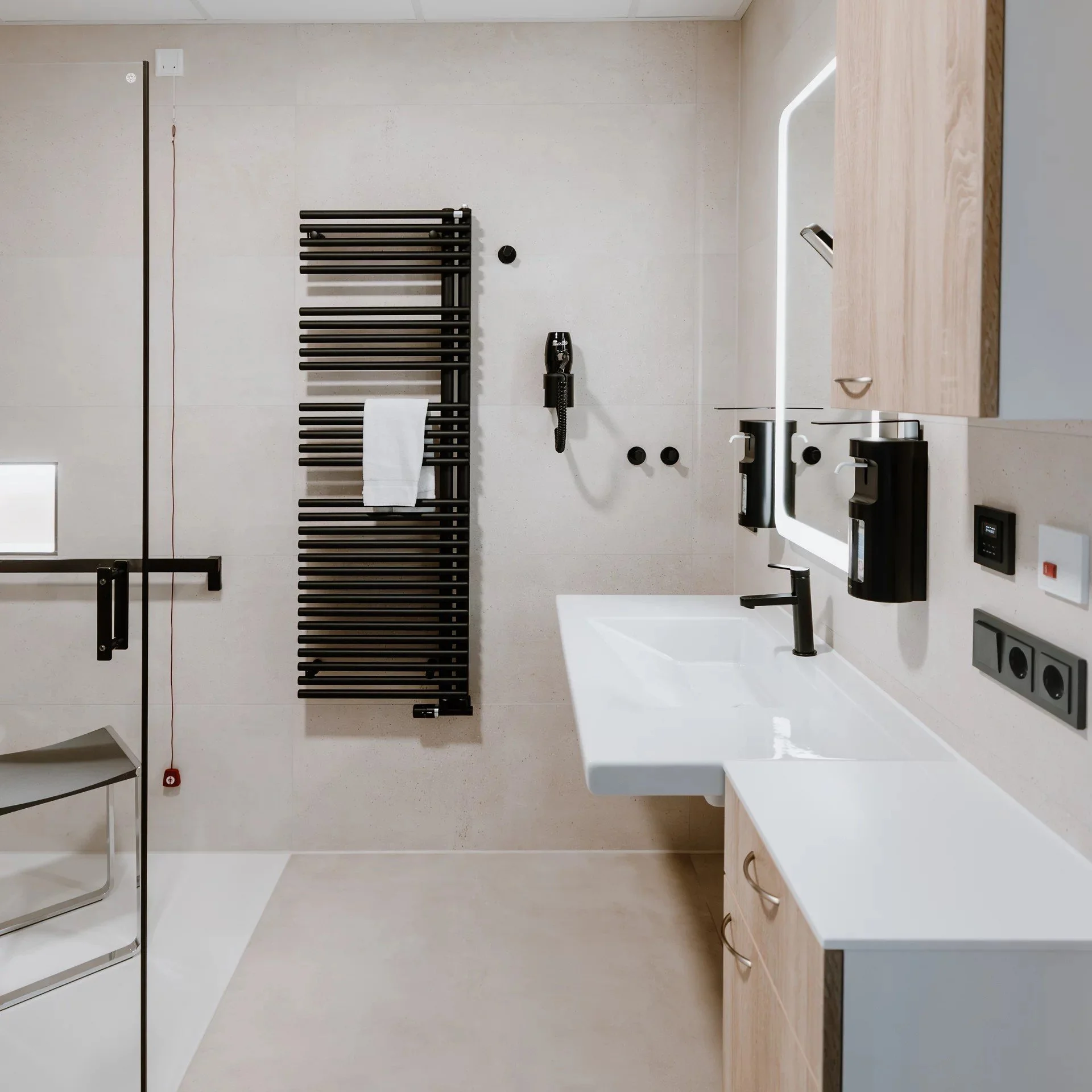
The material moodboard: Accessibility and aesthetics are not mutually exclusive and moodboards are instrumental in understanding the interplay between various finishes and fixtures and the overall look. Image courtesy of Keuco Gmbh
If there’s one change for an aging-in-place bathroom we’d recommend, it’s a wet room. When the technical aspects of plumbing are carefully understood and implemented to ensure a flush threshold providing barrier-free entry, with recessed shower trays, shower seats, and discreet grab rails, it can truly transform the bathroom experience back to being relaxing and enjoyable. Modern wet rooms are essentially walk-in showers. There’s no step to navigate, and the entire floor is gently sloped toward a drain. For privacy you may want to consider integrating curtains, which make standard cumbersome glass enclosure shower doors redundant.
Anti-slip tiles with a slip resistance rating over R10 can look good and provide grip underfoot. A built-in teak bench looks like a deliberate design choice rather than a necessity. Built-in fold-down shower seats can be an easy way to ensure accessibility. Depending on ability, some accessible designs feature an emergency alarm system within easy reach of the floor and shower seat.
Walk-in bathtubs are also extremely useful and come in a wide variety of designs if you enjoy submerging yourself in water on a regular basis but have trouble stepping over the side of the bathtub.
They should feature low-level entry, slip-resistant surfaces, grab rails, and seating options. Walk-in baths that take up less space may also be usable depending on mobility level.
Wet rooms have also become trendy in the recent years, making spaces feel larger and more luxurious and are often found in high-end hotels and spa bathrooms. The cost is significant; however, it’s an investment that increases value.
Heating Bathrooms for Thermal Comfort
When providing comfort one cannot overlook underfloor heating. The warm floor feels luxurious and dry under bare feet. Removing radiators or space heaters provides extra space that makes the bathroom easier to move around in. There are no exposed pipes or hot surfaces to worry about, and the integration of this floor based heating system prevents accidentally drilling through pipes hidden in walls later. We have the layout of ours filed away with the bathroom paperwork. For additional heating, we added a wall-mounted electric heater for cold days, providing extra warmth when needed.
Safety Features
Traditional chrome rails looked exactly like what you’d find in a hospital toilet, which is what most users find uncomfortable as they remind you of hospitals. However, providing for future installation of grab rails when really needed is easy if provision is made for fixing them at correct locations in the walls as part of the renovation works.
During the framing phase, place solid wood blocking between vertical wall studs at the desired height and location of future grab rails. It’s important to determine optimal height and locations. This is an instance where you must have drawings to ensure all adaptations are made correctly to the right height and reach of the user.
Grab rails needn’t be eyesores as the bathroom hardware market continues to evolve to suit demand and has completely changed. Grab rails now come in matte black, brushed brass and aged bronze options, giving much-needed variety.
We made sure the rails contrasted with the wall colour - our matte black rails stand out clearly against light grey walls. This helps my aunt locate them quickly, which becomes more important as vision changes with age.
Near the toilet, we installed an L-shaped rail on one side positioned 200mm in from the corner and 700mm from the floor. On the other side, there’s a drop-down rail at 320mm from the toilet centre that can be flipped up.
This creates a 640mm gap between the rails and is crucial for safe transfers if my aunt ever needed to move from a wheelchair.
Drainage
Containment and drainage of water is an important matter in an
accessible bathroom. It is important that the slope of the wet area is gentle and falls under the maximum recommended slope for good drainage and safety. Recessed shower trays are a must in a wet area as there must be no level difference of threshold when entering the wet area.
Toilets
The same thinking applied to the toilet itself. Modern “comfort height” toilets are slightly taller than standard, and are now common in upscale bathrooms. The overall height including the seat is 480mm from the floor, which is ideal for safe transfers and to avoid over straining when changing position.
Choosing a wall-hung toilet with a hidden cistern is especially suitable for an accessible bathroom as it keeps the floor free for wheelchair access.
This looks sleek and contemporary while being easier to clean around. The positioning is important: we kept it at least 500mm from the side wall to allow for the rail, with 1,000mm of clear space on the open side and 1,200mm in front.
It is advisable to have a spatula flush (a type of toilet flush handle designed with a long, broad, flat paddle for easier operation) rather than buttons or a rounded handle, and we positioned the toilet roll holder below the L-shaped rail as a loose-leaf type, which is easier for arthritic hands.
The Power of Good Lighting
Lighting makes an enormous difference in navigating spaces safely and comfortably, as more light is needed as one ages and eyes require higher luminance levels.
We installed several layers: recessed ceiling spots with a closed diffuser type for general illumination, LED strips under the vanity creating a soft glow to help navigate at night, and excellent task lighting on either side of the mirror.
Everything is on dimmer switches so she can adjust brightness. The light switches are positioned just outside the bathroom door at 900mm high - about waist height - making them easy to reach for all mobility needs. With integrated night lighting provided by the under vanity LEDs, one can now safely use the bathroom at night without fumbling for light switches in the dark.
Motion sensor lights are also excellent features to explore, as well as a humidity-controlled extractor fan that switches on with the lights.
With aging and visual impairment, there is an increased need to ensure higher light levels overall while reducing glare to a minimum. Fittings that reduce glare may be fixed on the ceiling in the form of recessed ceiling lights, as well as at eye level on walls as wall lights with shades that provide indirect light.
Another excellent product that is popular now is LED mirror lighting, which has the light source on the underside of the mirror, discreetly providing ambient light while avoiding glare.
Smart Taps and Temperature Control
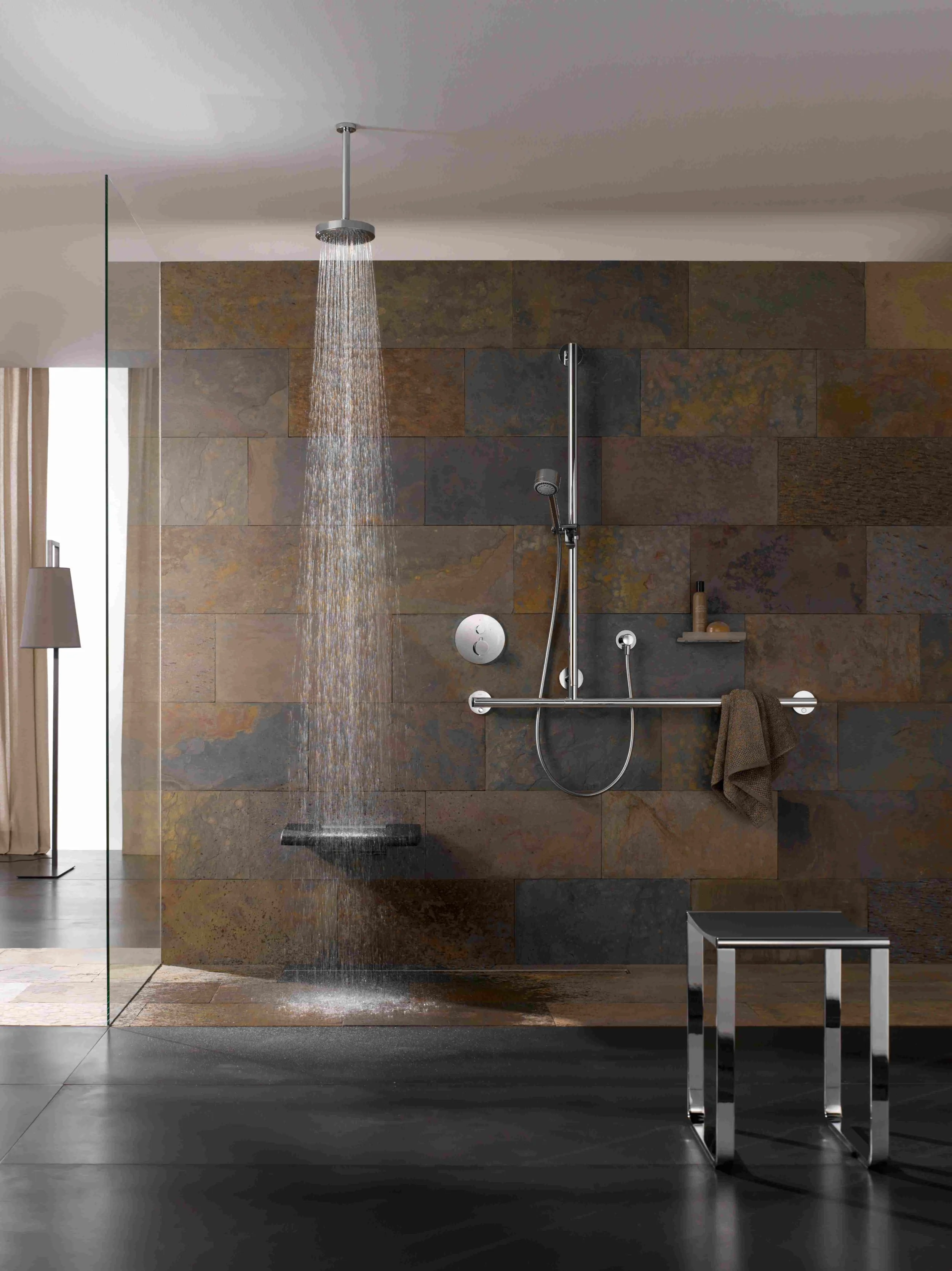
Smart taps and built in shower seats can make the experience of bathing hassle free for disabled users. Image courtesy of Keuco gmbh
Thermostatic mixing valves can be integrated that limit the maximum hot water temperature to 41°C at the basin outlet and ensure occupant safety by avoiding scalding.
There is a variety of lever type taps should be used so you only need one hand to operate the tap, as well as smart taps that can be controlled through touch, gesture, remote
control or can be voice activated. This is especially useful with showers and walk in bathtubs.
For the shower, we chose digital controls with a thermostatic device that can be preset to her preferred temperature. The controls are positioned between 750mm and 1000mm from the floor – the ideal height for ease of use whilst seated or standing.
The showerhead should be adjustable on a 1000mm sliding bar, starting at 750mm from the floor, with a 1500mm hose that reaches everywhere needed.
The controls and showerhead are positioned 500mm in from the corner on the wall next to the shower seat - close enough to reach but not where they’ll accidentally be knocked. Newer thermostats can be remote controlled, or voice activated.
The Vanity and Storage Rethink for Accessibility
Pedestal sinks should be swapped with a floating vanity and sink - essentially a wall-mounted cabinet with the sink set into the top. The basin itself can be a shallow fronted bowl, securely fixed at 780mm above floor level.
According to the occupational therapist, this was the sweet spot. High enough to prevent overreaching but still with knee space underneath. The plumber used flexible supply and waste pipes, which allows for height adjustment in the future if needed.
The counter space on either side holds her everyday items within reach. The drawer below has soft-close mechanisms and organizers inside, so everything has its place.
The provision of shelving in a recessed alcove, lit by LED strips, was a deliberate design feature showcasing her nice towels and a small plant, meaning frequently used items are visible and accessible at eye level.
The Floor: Creating a Safe Surface

Smart taps and built in shower seats can make the experience of bathing hassle free for disabled users. Image courtesy of Keuco gmbh
Crucially, it’s important that floor is practically level throughout,
accounting for minor falls towards drainage. For higher grip surfaces, rubberized floors or anti-slip vinyl are excellent choices and come in a variety of colours, whilst you can also select slip resistance tiles that are textured if you prefer this aesthetic.
The tile transition into the wet room area must be at the same level, with just the gentlest slope toward the drain - imperceptible unless you’re looking for it. This creates a seamless appearance while being far safer than any kind of step or enclosure.
For those considering similar changes either himmelzimmer can assist in undertaking a home evaluation for your current needs, or you can start with an occupational therapist assessment.
They understand how conditions progress and what adaptations will serve both current and future needs.
We can help to work out interior layouts, furniture, fixtures, and equipment, and engaging trusted contractors for the delivery of your project through our project management services.
For the design conscious we suggest you study design magazines and high-end bathroom showrooms to identify styles you love, then work backward to incorporate necessary features. This approach yields better results than designing a functional bathroom around the equipment you need.
We always develop elevations and 3D renderings of an interior space when working to understand the visual aspects you may want to experiment with before finalizing the design. This also allows you to test out different colour and material schemes before committing to a preferred palette.
It’s important to prioritize the big things: provision of level access, integrating the correct equipment at appropriate heights, allowing for adequate space for future accessibility challenges, providing good lighting and installing slip-resistant flooring. These are harder to change later.
Choose quality over quantity. Better to have fewer, well-chosen features that get used than a bathroom full of overwhelming equipment.
A Final Thought
The bathroom is where we start and end each day. It’s where we take care of ourselves in the most personal ways. It deserves to be a space that supports us while feeling like home - comfortable, attractive, and truly ours.
Renovating for accessibility doesn’t mean giving up on beauty or accepting decline. It means being wise enough to plan, creating spaces that will serve us well through all of life’s stages without announcing themselves as “adapted” or “accessible.”
Thanks to careful considerations and forward planning, accessible bathrooms can be beautiful, functional spaces that also happen to be safer and easier to use.
If you’re facing similar decisions for a loved one or yourself, take heart. With thoughtful planning and good advice, and help from designers like himmelzimmer, you can create something that works practically while looking wonderful.
References
British Standards Institution (2018)
BS 8300-2:2018 Design of an accessible and inclusive built environment. Part 2: Buildings – Code of practice.
London: BSI Standards Limited.Granberg (n.d.)
Accessibility Solutions Catalogue.
Available at: www.granberg.com (Accessed: 20 January 2026).Habinteg Housing Association (2010)
Lifetime Homes Design Guide. 2nd edn.
London: IHS BRE Press.Keuco (n.d.)
Universal Design Catalogue.
Available at: www.keuco.com (Accessed: 20 January 2026).Preiser, W.F.E. and Ostroff, E. (eds.) (2011)
Universal Design Handbook. 3rd edn.
New York: McGraw-Hill Education.Pynoos, J., Nishita, C. and Perelman, L. (eds.) (2014)
Aging in Place: Designing, Adapting, and Enhancing the Home Environment.
New York: Routledge.Barrier Free Environments Inc. (1991)
The Accessible Housing Design File.
New York: Van Nostrand Reinhold.