
Considerations for Accessible Kitchen Design
Independence in Later Life Is About the Details
Recently a friend of ours named Sarah was telling us about how her 70-year-old mum had tripped as she over-reached to get to a pot in her kitchen in a cupboard above the worktop. She had a fracture from the fall on her hip and eventually needed an operation. With her mother physically vulnerable, Sarah decided it was time her mum’s house was adapted to better suit senior living so that she can age in place in comfort within a home environment that is suited to her needs.
Being from the baby boomer generation Universal Design was not an unfamiliar term for Sarah’s mum. Suffering from arthritis, she knew that damage to the bone structure can cause issues with bending and lifting things. Pots can feel heavier and floors can feel treacherous if uneven.
"It was a no-brainer," Sarah said and looking back her mum says she can’t remember how she coped previously with a kitchen that did not cater to her changed mobility needs. "The best way forward in these situations is to make life as comfortable as possible and to remain as independent as possible for as long as possible" she added, and her mum appreciates being able to stay close to her friends and familiar places.
Space and Layout

The layout: The oven, hob and sink should be arranged along a single continuous worktop, with sufficient surface area provided to allow safe and practical food preparation without interrupting general circulation flow through the house
In addition she is only too happy now with her regained independence that the new renovated kitchen afforded her. Retrofitting for senior living is increasingly important as our mobility decreases with age and the cost of moving becomes high. This article seeks to summarize some key considerations that need to be taken in to account when retrofitting a kitchen for ageing in place.
Before starting a kitchen retrofit, it is important to understand the spacing and layout. The aim is to create clear, uncluttered space that is safe and has room for movement. Before cupboards, ovens, and hobs can be fitted, a review of the items you currently have that can be reused is useful as well as a plan of the kitchen to scale.
Circulation space is essential to any accessible kitchen design project and having an architectural plan to scale as well as an understanding of the functional kitchen goods you want to include is necessary to gauge the remaining space you have for circulation as well as suitable layouts.
The next step is designing a simple sketch layout that will accommodate wheelchair or mobility impaired users, and this means allowing a lot more circulation space than your typical kitchen. However, when done right improvements in circulation can make the whole space flow well, kitchen tasks seem significantly easier and be truly life enhancing.
Consider if you need to move and resize the entrance doorway to the kitchen to maximize the effective use of the space. If necessary, ensure that there is plenty of room for the turning circle of a wheelchair and clear manoeuvring space around the door.
The layout: The oven, hob and sink should be arranged along a single continuous worktop, with sufficient surface area provided to allow safe and practical food preparation without interrupting general circulation flow through the house.

1. Motorised cupboard lifting system
2. Height adjustable worktops with stove
3. Anti glare lighting
4. AI powered smart fridge with activity monitoring & voice control
5. User friendly Smart home panel for controlling systems in the home
6. Motorised kitchen island with an accessible sink and adequate space underneath for wheelchair access
Design literature advises that typically a 1500mm diameter turning space with a larger 1500mm x 1800mm manoeuvring space is required in a kitchen for wheelchair access. In addition, there are many other considerations that assist those with mobility issues to navigate a kitchen space easier. For example, a minimum 300mm wide section of countertop space alongside the fridge and worktop space adjacent to the oven door are important to be able to place items on temporarily to navigate a space in comfort and safety.
It is also important to factor in the amount of storage available within a kitchen, in cubic metres per person, so everything is relatively easy and straightforward to access.
Similarly, it is important to remember to give as much continuous counter space as possible when designing. We would typically recommend a minimum worktop length of around 6.1m for a two person dwelling.
If you engage a design team like Himmelzimmer, appropriate consideration to spatial relationships and circulation will be accounted for as part of the design process.
Suppliers
Today in the UK market there are multiple suppliers that have created senior-friendly kitchen products that include customizable countertops, appliances, flooring, etc. Granberg, AKW, Hafele UK are just some out of the many that provide a wide range of products to suit varied physical abilities.
To expand on this further, Granberg offer fully motorized manually adjustable height worktops and sinks, giving users a wide adjustment range that is suitable for high mobility needs. AKW has an inclusive range that is simple and retrofit-friendly to improve safety and ease.
Hafele UK has a balanced combination of accessibility and design and provide design-friendly solutions that look good. Since they have a larger selection of products, it is easier to integrate them into a retrofit for a cohesive aesthetic.
High street brands like Wren and Howdens do offer accessible kitchen options however at the point of writing their ranges are limited in terms of accessibility.
How to Retrofit Your Kitchen for Ageing in Place
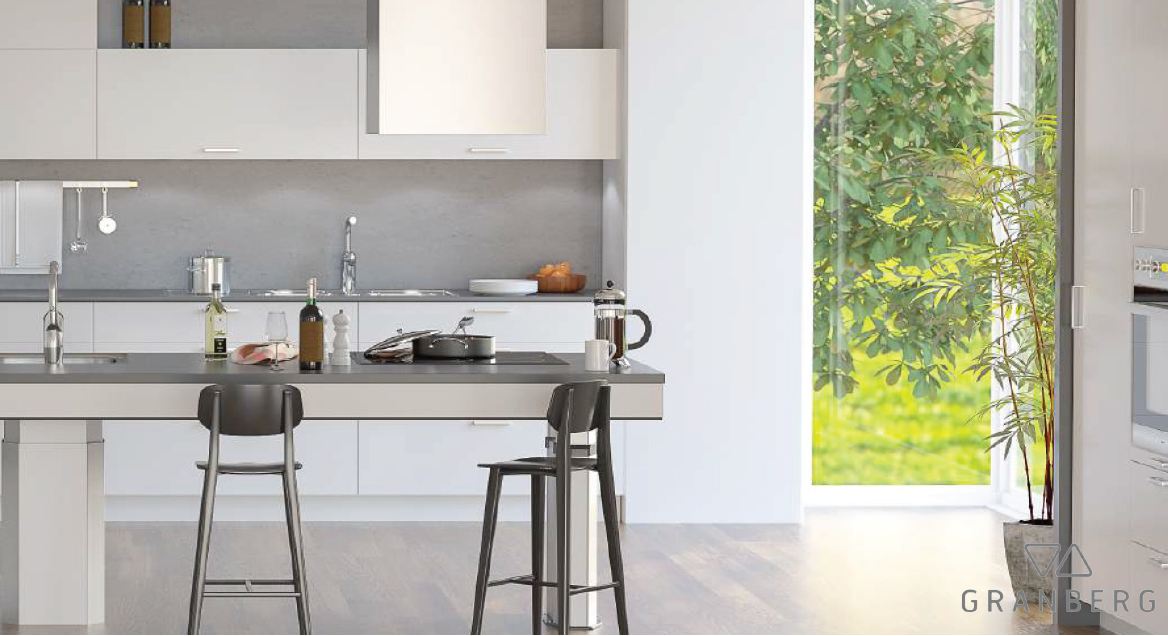
Kitchen worktops with lifts can be adjusted to suit individual needs and can incorporate sinks, induction hobs and can have movable bins slotted in
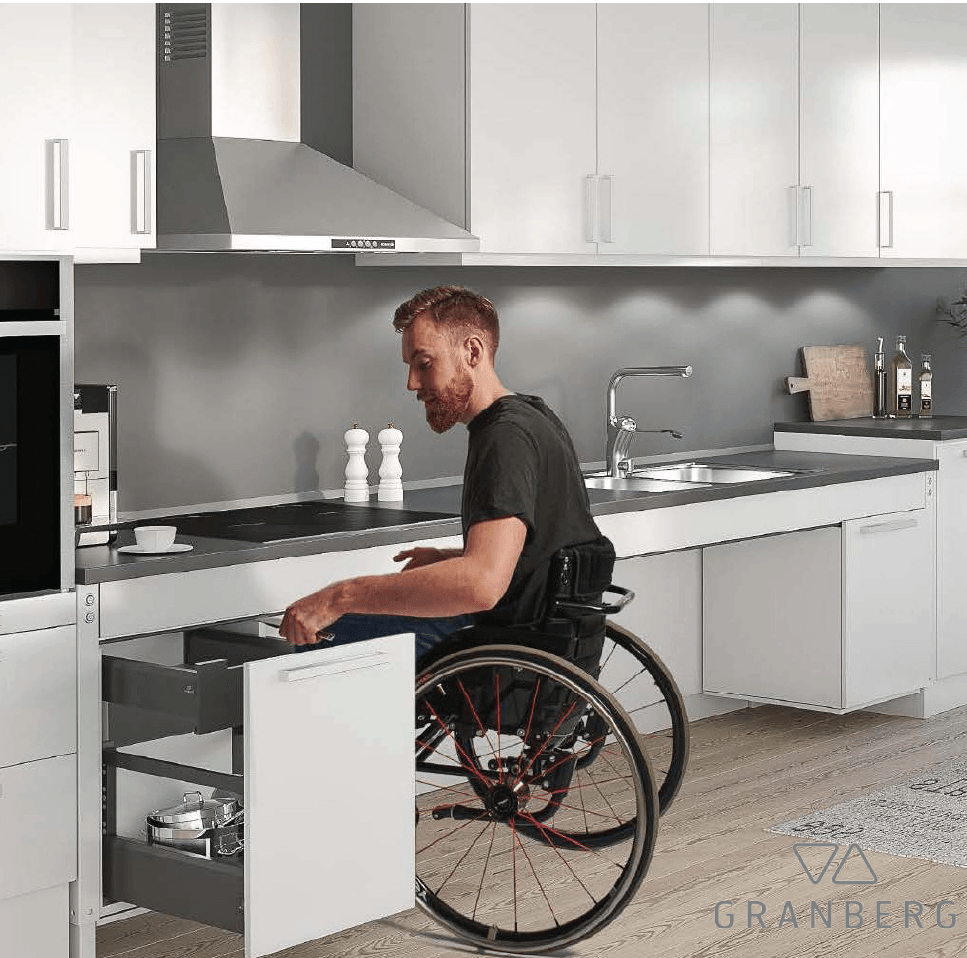
A well designed wheel chair accessible kitchen should provide independence, safety and support healing and wellbeing
Once the parameters of an accessible kitchen have been drawn out on a schematic level, it is important to select products that ensure mobility. Once clear floor space and wider walkways are delineated along with wider doorways, the next step would be adding the main items of a kitchen. The hob or oven, sink, and fridge need to be laid out diagrammatically to ensure they are located close to each other for ease of cooking.
Furthermore, the kitchen and dining areas should be combined or directly connected so that a wheelchair user can easily carry food between the two.
Building Regulations
If designing for wheelchair accessibility without professional input, a good reference for key design relationships (spatial configurations and dimensions) is the Approved Document Part M of the building regulations. This has minimum design requirements that need to be adhered to for new buildings that integrate wheelchair accessible spaces.
Another key reference document of note is the Habinteg Wheelchair Housing Design Guide: 3rd Edition. This can be a good source of information to understand spatial requirements when designing.
Upgrade to Touch or Motion Activated Taps
Modern sensor taps eliminate the need to twist or grip, reducing strain on wrists and hands. Many models allow temperature pre-setting, preventing accidental scalding. Brands like Grohe offer stylish options that look nothing like medical equipment and can be integrated seamlessly into a modern, well-designed contemporary kitchen.
Improve Lighting with Layered Solutions
Good lighting is essential for ageing in place in comfort and is most necessary in the kitchen as many tasks carried out require high levels of illumination in addition to the need for additional light as we grow older. Good lighting reduces eye strain and prevents accidents.
With high illuminance levels, it is important to ensure glare is avoided. This can be done by specifying anti-glare lighting. Try to combine anti-glare ceiling lighting with under-cabinet LED strips and anti-glare task lighting above work areas to suit the variety of lighting conditions that are desired within a kitchen.
Motion-sensor lights inside cupboards and drawers eliminate fumbling in dark spaces. It is also worthwhile incorporating lighting improvements as part of a smart home system to ensure that changes in lighting requirements throughout the day, such as colour temperature and intensity, can be incorporated without any additional attention from the user, and so that the lights can be voice controlled.
Install Pull-Out Shelving and Drawers
To reach objects easily without having to overextend yourself, replace deep, fixed cupboards with pull-out shelving systems that glide smoothly on soft-close runners. Consider carousel units for corner cupboards that bring items to you rather than requiring you to hunt for them. This eliminates the need to crouch or reach into dark corners.
A newer development from suppliers are pull-down cupboards that can be lowered to the height of a wheelchair user, eliminating the need to reach up.
Lower Worktop Heights in Key Areas to Suit Wheelchair Use
Kitchen worktops need to be installed lower to suit wheelchair users or have inbuilt adjustability to suit the ideal level for a wheelchair user. Having considered upper limb strength and changes in wheelchairs over the years which have differing heights, usually the best solution for this is a motorized height-adjustable countertop.
Height-adjustable countertops which integrate sinks and hobs can ease overall functionality of an accessible kitchen, and an electric adjustable button is more suitable than a wind-up manual system which may not be practical as the capability of the user changes.
The depth of the worktop is also important, in particular for wheelchair use. It is important to ensure that a wheelchair user can wheel far forward enough to access the back of wall units and drop-down cupboards, sinks, or taps. Installers should be aware of the requirement for flexible pipes and wiring in height-adjustable countertops.
While standard worktop height is 900mm, consider creating varied work zones with heights between 750-850mm for seated work or easier standing tasks. A section of lowered worktop near the hob or sink can make meal preparation far more comfortable.
Another key consideration is ensuring that there is space for legs under the counter and under the work surfaces so that a wheelchair user can get to the edge of the countertop. This is paramount for when a wheelchair user needs to reach the back wall for appliances, switches, and sockets.
To ensure a clear leg space it is recommended to avoid diagonal struts in the worktop fixings.
Choose an Induction Hob with Auto-Shutoff
Induction hobs offer precise temperature control, stay cool to touch, and typically include safety features like automatic shut-off if a pan is removed or cooking time exceeds a set limit. The flat surface is also easier to clean than traditional gas or electric hobs, making them ideal appliances to integrate into a new kitchen design.
Flooring - Install Non-Slip Flooring
Flooring that is non-slip is a priority, which means polished timber floors and rugs are to be avoided. Clear anti-slip coating or a water-based polyurethane finish can be added to timber to increase slip resistance.
Alternatively opting for timber with a naturally textured surface, such as brushed, hand-scraped, or distressed wood, provides better inherent traction than a smooth, high-gloss finish.
Vinyl and cement screed work well as they are easy to clean and durable. Rubberized flooring is an excellent way of adding safety while having a full range of colours. A slip resistance rating of R10 or above is desired to avoid creating a slipping hazard. Make sure to check this prior to purchase.
Position Frequently Used Items at Mid-Height
Store everyday items - kettle, toaster, commonly used ingredients - between waist and eye level to eliminate unnecessary reaching or bending. Use vertical drawer dividers to keep items visible and accessible rather than stacked.
Install a Shallow Sink
Shallow sinks allow the user to get closer to the tap as the space underneath the tap can be kept free. Shallow sinks are about 120-150mm deep and should ideally be insulated at the bottom (if exposed, to avoid scalding a wheelchair user’s legs) and have a rear waste trap.
Providing around 500mm on either side of the sink for dirty dishes and washed dishes to be kept before and after cleaning is also an important consideration for ease of use.
Install a Side-Opening Oven
Side-hinged ovens could be worth considering as they allow a user to slide racks out without reaching over a hot door, significantly reducing the risk of burns.
We suggest positioning the oven at a comfortable height, typically with the middle shelf at elbow level, to eliminate bending. Ideally there is a pull-out shelf integrated underneath the oven that can be used to temporarily place hot items from the oven for inspection.
The ideal height for the oven should be with the horizontal centre line of it at 1000mm above the floor level.
Easy Swaps
Keep most appliances on the countertops instead of inside cupboards.
Prioritise drawers over cupboards.
Consider whether grabrails would be beneficial to be integrated at the point of retrofitting. Users can then move along worktops easily without having to physically move their wheelchair.
A Kitchen that Changes with You
The above changes can make a massive difference in how long a kitchen remains viable when living on your own. It should tell a story of adapting to change in the best way possible and uplift and inspire independence.
Are there issues of accessibility in your current kitchen that you have just learnt to live with? Maybe it is a shelf that is out of reach or a drawer that needs pulling with force?
What small change in your kitchen would make the biggest difference to your daily life?
Share your thoughts on our social media posts on this subject, or if you are wondering what is possible in your own home, we would love to explore that with you. After all, the best time to future-proof your kitchen is not when you need it - it is before you do.
References
AKW (n.d.) AKW accessible kitchens catalogue. Middlewich: AKW Ltd. Available at: https://www.akw-ltd.co.uk/document/kitchen-catalogue/ (Accessed: 16 December 2025).
Centre for Accessible Environments (2018) Wheelchair housing design guide. 3rd edn. London: RIBA Publishing.
Granberg (2023) Height adjustable kitchen systems. Norrkoping: Granberg Interior AB.
Grohe (n.d.) Kitchen taps. Available at: https://www.grohe.co.uk/en_gb/kitchen/mixer-taps.html (Accessed: 16 December 2025).Hafele UK (n.d.) Inclusive kitchens. Available at: https://www.hafele.co.uk/en/info/inspiration/inclusive-living/inclusive-kitchens/226896/ (Accessed: 16 December 2025).
HM Government (2015) The Building Regulations 2010: Approved Document M - access to and use of buildings. Volume 1: Dwellings. London: NBS.