
Retrofitting Your Home for Aging in Place: Considered Spaces to Grow Old In

A staggering 96% of adults over 65 consider aging in place an important goal, yet only 10% of British homes are considered aging-ready [1],[2].
The Need for Homes Adapted for Independent Living
A staggering 96% of adults over 65 consider aging in place an important goal, yet only 10% of British homes are considered aging-ready [1],[2]. This profound disconnect between desire and reality represents one of the most pressing housing challenges of our time.
The numbers tell a compelling story. With one in four UK residents expected to be over 60 by 2040, the traditional model of late-life residential transitions is becoming increasingly unsustainable. Care homes, once the default option, face a capacity crisis with 165,000 additional beds needed by 2040.
Meanwhile, the financial mathematics of aging in place speak volumes. According to the not-for-profit organization Paying For Care, the average cost of standard residential care exceeds £64,000 annually for the South East of England. In contrast thoughtful modifications to an existing family home or after downsizing to a more manageable property typically requires a comparatively modest one-time investment of £15,000-£70,000 depending on works required [3].
This one-time expenditure, when properly executed, supports decades of independent living while simultaneously increasing property value.
But this is not merely an economic calculation. Research consistently demonstrates that individuals who age in familiar environments experience better mental health outcomes, maintain stronger social connections, and preserve their sense of identity and autonomy. The home becomes more than shelter - it transforms into a vessel for dignity, independence, and continuity of life as we expect it to be.
The evidence supporting aging in place extends beyond individual preference to measurable health outcomes. Studies show that older adults who remain in their homes longer experience reduced rates of depression, maintain cognitive function more effectively, and report higher life satisfaction scores [4]. The familiar environment provides what researchers term “environmental mastery” - an intimate knowledge of space that compensates for declining physical abilities.
Yet the current housing stock presents formidable barriers. Narrow doorways designed for younger bodies, bathrooms that become obstacle courses, and staircases that transform from daily conveniences into impassable mountains.
The challenge is not just about accommodation - it is about transformation - converting homes from spaces designed for one life stage into adaptive environments that evolve with their inhabitants. Remodelling homes for accessibility is without a question required.
This transformation requires a fundamental shift in thinking. Rather than viewing aging as decline it is a continuation of life’s journey on your terms, supported by a combination of thoughtful design and skilled delivery of home modifications.

Studies show that older adults who remain in their homes longer experience reduced rates of depression, maintain cognitive function more effectively, and report higher life satisfaction scores [4].
Accessibility: Opening Doors to Independence
As the body’s mobility decreases, narrow doorways create a considerable challenge. The 76cm doorways that seemed generous decades ago can begin to feel claustrophobic. Even a single step can become a daunting barrier.
This experience illuminates the first principle of aging in place retrofitting: accessibility is not about adding features - it is about removing barriers.
The transformation begins with width - the simple act of expanding doorways from the standard 76cm to a minimum of 85cm, with 90cm preferred, creates a psychological as well as physical opening.
These extra centimetres represent the difference between navigating cautiously and moving confidently.
Hallways are similar. The traditional British hallway, often barely wide enough for two people to pass, becomes a navigation challenge when mobility aids enter the equation. Research shows that 120cm width is needed to comfortably allow wheelchair passage, while 150cm accommodates turning movements. But these are not just measurements for future needs - wider corridors create a sense of spaciousness that benefits all inhabitants.
The staircase, often the focal point of period homes, requires particular sensitivity. The goal is not elimination but enhancement. Widening staircases to 107cm accommodates future stairlift installation while ensuring two people can comfortably pass - crucial when one person needs assistance.
The addition of a second handrail, necessary when a staircase width increases beyond 1m, provides security without compromising aesthetics.
Where stairs become prohibitive, residential lifts offer liberation. Modern home elevators, far removed from the utilitarian boxes of institutional settings, can be integrated seamlessly into domestic architecture. Pneumatic models require no machine room, operating on air pressure alone, while through-floor lifts can be discretely housed within enlarged cupboards.
The external environment demands equal attention. The journey from car to front door, often overlooked in accessibility planning, can become the determining factor in social participation. Gentle ramps, integrated into landscaping rather than bolted on as afterthoughts, maintain the home’s visual integrity while ensuring universal access.
Materials matter here - textured concrete provides grip without appearing institutional, while subtle colour contrasts guide movement for those with visual impairments.
Threshold design represents another subtle but significant intervention. Flush thresholds, achieved through careful floor level coordination can eliminate daily obstacles while maintaining thermal performance through advanced sealing systems and creating an opportunity to add underfloor heating for uniform thermal comfort.
Perhaps most importantly, accessibility modifications must anticipate change. Blocking for future grab rails installed during initial renovations can be very cost effective. Electrical circuits designed to accommodate future stairlifts and wider doorframes that appear decorative but enable wheelchair access ensure homes adapt gracefully to changing needs.
When done thoughtfully, accessibility benefits all - from grandchildren to guests with temporary injuries - becoming a foundation for better living, not just aging in place.
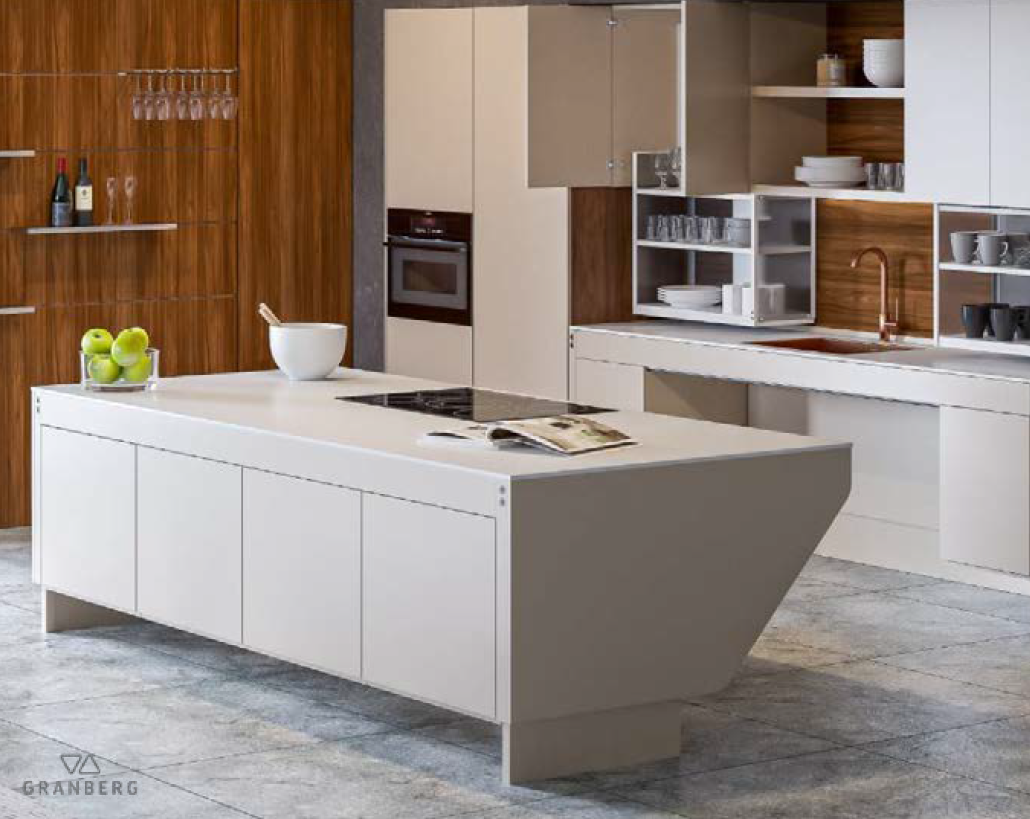
A kitchen featuring pull down shelves within over head cupboards and height adjustable sinks. Image courtesy of GRANBERG.
Connectivity: The Digital Nervous System
With a smartphone and smart hub seniors can now adjust their home’s temperature from their morning walk, check who is at the door from their garden, and monitor blood pressure with a device that automatically shares readings with their GP. Such systems enable independence in later life.
Smart home systems extend far beyond convenience to safety and health monitoring. Sensors embedded discretely in floors detect falls, unusual movement patterns, or prolonged periods of inactivity.
These systems learn individual routines - understanding that a resident always makes tea at 7 AM means that sensors can identify deviations that might indicate distress, reducing false alarms while providing genuine security.
Medical alert systems have evolved from simple single-button devices to sophisticated platforms integrating smartphones, smart watches, and home systems. Modern devices detect falls automatically, monitor vital signs, and can summon help without conscious activation.
Telehealth platforms transform homes into healthcare hubs. High-definition cameras, integrated weighing scales, and blood pressure monitors enable regular consultations without travel.
Smart doorbells and security systems provide both safety and social connection. Video doorbells allow residents to communicate with visitors without physically approaching the door.
Voice-activated controls represent perhaps the most transformative accessibility technology. Amazon Alexa, Google Assistant, and Apple Siri become digital companions, responding to spoken commands to control lighting, heating, security systems, and entertainment.
For individuals with limited mobility or dexterity challenges, voice control restores agency over their environment.
Safety: Creating Sanctuaries, Not Hospitals
Designing homes that allow residents to grow old with dignity requires more than aesthetics and comfort - it demands an unwavering focus on safety.
Fall prevention begins with understanding that most falls occur during routine activities in familiar spaces. One in three adults over 65 falls each year [5], with bathroom and bedroom incidents accounting for the majority.
Grab rails have evolved from institutional features into sophisticated design elements that integrate seamlessly into bathroom aesthetics.
Flooring choices also influence safety. Luxury vinyl planks can mimic hardwood while offering superior slip resistance and cushioning. Textured tiles in wet areas maintain elegance while reducing risk.
Lighting becomes a navigation system. Consistent, shadow-free illumination eliminates contrast zones where accidents occur. Motion-activated systems ensure pathways remain illuminated during night-time movements.
Security systems, emergency lighting, and backup power options further enhance safety while maintaining independence.
Comfort: Creating a Home with Manageable Spaces
Another key consideration is how to make spaces comfortable with reduced mobility.
Bespoke cabinetry exemplifies adaptive design. Pull-down upper cabinets can lower smoothly to counter level, bringing plates and cutlery within reach.
Height-adjustable sinks and cooktops accommodate both standing and seated use.
Underfloor heating provides consistent warmth and prevents the discomfort of cold floors. Zoned climate systems allow different areas to maintain different temperatures, accommodating varying comfort needs throughout the day.
Voice integration and central control panels simplify operation of lighting, heating, security, and entertainment systems.
Automotive access innovations such as car turntables eliminate the need for reversing from tight driveways, allowing vehicles to rotate 180 degrees for easy exit.
Furniture selection also plays a role. Chairs with firm cushions and supportive arms assist with sitting and standing, while built-in seating along hallways offers rest stops during movement through the home.
Storage solutions address the challenges of reaching and bending. Pull-out drawers and rotating corner units make daily tasks easier for people of all ages.
The cumulative effect of these comfort modifications creates homes that anticipate needs rather than react to limitations.
Psychological, Social, and Economic Imperatives
In Britain the conversation around aging in place transcends individual preference to become a societal imperative.
Beyond the comfort of familiar surroundings lies environmental competence - deep spatial knowledge that helps seniors navigate despite physical changes.
Homes modified for aging in place preserve this relationship while adapting to changing needs. The result is maintained self-efficacy and stronger mental health outcomes.
Social connections remain stronger when anchored in familiar neighbourhoods. Older adults who age in place maintain larger social networks and engage more frequently with their communities.
The broader economic implications extend beyond households to national policy. Every person who successfully ages in place reduces pressure on the care system while continuing to contribute economically to their communities.
Property developers increasingly recognise aging in place as a market opportunity. Homes designed or modified for accessibility attract buyers across demographics, with wider doorways and accessible bathrooms viewed as lifestyle enhancements.
Environmental benefits also play a role. Retrofitting existing homes produces far less carbon than new construction.
The retrofitting of Britain’s housing stock for aging in place represents one of the great design challenges of our time. It demands technical innovation, aesthetic sensitivity, and social awareness.
Most importantly, aging in place is not about enabling decline - it is about supporting continued engagement with life in all its complexity.
References
Centre for Ageing Better (2022) The State of Ageing 2022 Summary.
Gibson, K. et al. (2024) ‘It’s where I belong’: what does it mean to age in place from the perspective of people aged 80 and above? BMC Geriatrics.
Laing, W. (2025) Care Homes for Older People UK Market Report.
Yan, L. et al. (2020) Living arrangements and life satisfaction. BMC Geriatrics.
TakingCare (2023) Elderly people and falls: how healthcare can better support the UK’s ageing population.
6-18. Additional academic and policy sources relating to ageing in place, housing, and gerontology.