
Designing Homes for Life: Why Longevity Architecture is the Future of Living Well
An Aritco & Himmelzimmer Collaboration
A question that most people find themselves asking at some point in their lives is: "Can I realistically live in my home for another 10 years?" When considering your future, it’s important to be aware that the costs associated with good care homes are in most cases prohibitively high. Added to that, in the last decade the number of over-65s increased by 23%, while the total UK population only grew by 7%, creating a strain on suitable housing supply1, making the importance of longevity architecture ever more paramount.
Longevity architecture, a relatively new term coined to describe buildings that actively support human health over a lifetime, is increasingly being used as a means of addressing this growing need. Consideration of materials that promote health, spatial design for accessibility, good lighting and ventilation, as well as consistent thermostatic control of ambient temperature are some of its main pillars. The aim is to help users move comfortably through the building at all life stages, while also helping them to think better, sleep better and age more slowly. Physical and mental health, healing of the body, wellbeing and independence have become words closely intertwined with longevity architecture. The core concepts of this science and philosophy are spaces for human health and enduring buildings. It considers not only the physical environment but also the social environment and individuals' connection to their surroundings. Designing homes for life is the future of living well, and this is delivered through the lens of longevity architecture.
Spatial design
Spatial design and its impact on cognitive load in navigating spaces easily and without confusion is important to consider. Spatial proportions, complexity and visual order influence cognitive processing. Materials, texture and colour tend to produce measurable changes in brain activity, stress hormones and cognitive performance. Comfortable homes encourage activity and socialising. Another important level of spatial design for new builds is adaptable layouts. Bathrooms and kitchens that can be made accessible to suit a user’s changing needs, or partition walls that can be relocated to create more space, are examples of this.
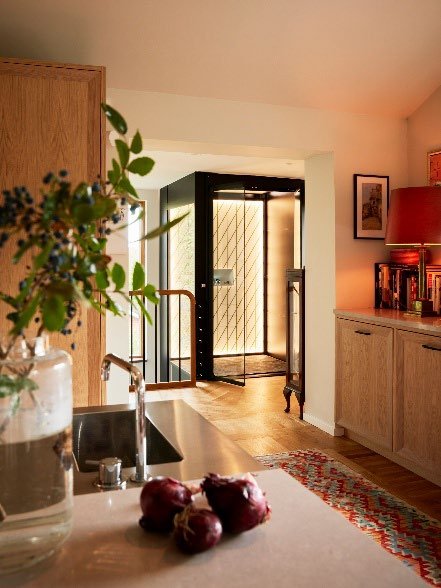
“How you access the entirety of a home as your mobility changes is a necessary consideration”- Image courtesy of Aritco
Biophilic design
In looking to create spaces for ageing well, the concepts of biophilic design and its healing properties are an important factor for the over-60s. Considerations to bring nature indoors through careful selection of materials, providing windows with views on to greenery and landscapes, integrating courtyards and allowing for low-maintenance planting schemes have all been shown to uplift moods and improve recovery times from illnesses².
Indoor mobility – lifts and other equipment
In the relatively compact urban environment in which the majority of the population lives, houses across multiple levels are common. How you access the entirety of a home as your mobility changes is a necessary consideration to avoid loss of amenity.
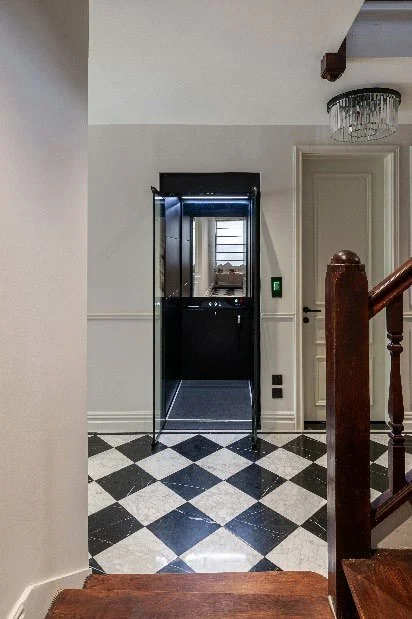
“it’s a sensible approach to design out steps where possible” - Image courtesy of Aritco
Bespoke lift solutions, such as those provided by Aritco can give access to all levels of the home and prevent debilitating and fatal falls from navigating stairs. Modern lift solutions can be thoughtfully integrated into an interior design aesthetic, offering a wide range of solutions to suit an individual’s circumstances. These can be discreetly designed to blend into an existing space or stand out as a feature. Aritco even offer the ability to customise the back wall of the lift to personalise further.
Looking at mobility challenges, it’s a sensible approach to design out steps where possible and introduce level thresholds throughout. Mobility solutions also prevent one from having to move to a single-storey home, avoiding the stress of a move and its associated impact on mental and physical health.
The Neighbourhood and Social Interactions
Embracing longevity architecture also benefits mental wellbeing through the strengthening of connections to your social network that have been built up over years, and keeps memories tied to the home that have been formed over a lifetime. Social integration as part of the longevity architecture story helps residents live longer and more rewarding lives.

A sense of community enhances wellbeing and is a key part of longevity.
A home designed to host others, that is well connected to the neighbourhood and is not closed off - with front gardens and porches that encourage neighbour interaction – reduces social isolation. The World Health Organization states that chronic loneliness and social isolation reduce life expectancy and increase the risk of premature death to a degree comparable to smoking 15 cigarettes a day³.
Longevity architecture is not only about the physical aspects of a building; it is also about the matrix within which the home sits. The community of friends, neighbours, family and extended family living in one locale is a great source of social engagement which needs to be nurtured and not severed through a house move due to mobility issues.
Having space for relatives to visit and stay helps to reduce the detrimental effects of loneliness and thereby increases life expectancy. Walkable communities with social amenities and access to local services that have become part and parcel of life also hold a value that goes beyond the practical.
Lighting for wellness
Older people often spend more time at home, so daylight matters more. Natural light affects sleep and mood. The light spectrum, its intensity and timing – which regulate circadian biology – have been proven to affect disease risk.
Sleep outcomes are improved when consideration is given to natural light exposure throughout the day, as has been demonstrated by multiple studies⁴. Circadian lighting systems on the market today are able to change the temperature of lighting as the day progresses to match natural daylight rhythms, allowing you to take advantage of these positive benefits in your own home.
Ensuring thermal comfort
In addition, thermal comfort provided by heating, ventilation, air conditioning and the materiality of your home has a big impact on wellbeing for all ages.
With the changing climate it’s important to plan ahead for temperature extremes and integrate sustainable approaches to control thermal fluctuations in your home to keep you comfortable. As one gets older, thermal comfort matters more. Cold homes can increase blood pressure and cause respiratory problems⁵. Good ventilation is equally important. Higher air quality has also been shown to improve cognitive performance.
Financial benefits
The financial benefits that come from staying in one's own home are many but primarily with astronomical care home costs, it makes more sense to protect your property and capital and adapt the home you live in for ageing in place.
Conclusion
Integrating concepts of longevity architecture in the home environment can have multiple benefits that include physical wellbeing, improved health outcomes, strengthening of social connections while also providing financial benefits.
Due to the increasing demand by the growing population of the over 65s it is becoming important to apply these principles to all homes we live in to enable them to support independent living for as long as possible.
References
House of Commons Library (2021)Housing an ageing population: a reading list. Available at: https://commonslibrary.parliament.uk/research-briefings/cbp-9239/ (Accessed: 13 May 2026).
Ulrich, R.S. (1984) ‘View through a window may influence recovery from surgery’, Science, 224(4647), pp. 420–421. Available at: https://doi.org/10.1126/science.6143402
Holt-Lunstad, J., Smith, T.B. and Layton, J.B. (2010) ‘Social relationships and mortality risk: a meta-analytic review’, PLOS Medicine, 7(7), e1000316. Available at: https://doi.org/10.1371/journal.pmed.1000316
Chellappa, S.L., Steiner, R., Oelhafen, P., Lang, D., Götz, T., Krebs, J. and Cajochen, C. (2021) ‘Recommendations for daytime, evening, and nighttime indoor light exposure to best support physiology, sleep, and wakefulness in healthy adults’, PLOS Biology, 20(3), e3001571. Available at: https://doi.org/10.1371/journal.pbio.3001571
Shiue, I. (2016) ‘Cold homes are associated with poor biomarkers and less blood pressure check-up: English Longitudinal Study of Ageing, 2012–2013’, Environmental Science and Pollution Research, 23(7), pp. 7055–7059. Available at: https://doi.org/10.1007/s11356-016-6235-y
FAQs
-
In most cases, yes – with the right design thinking and at home care to suit your needs. Longevity architecture is built around exactly this goal: homes that adapt to you as your needs change. From adapted bathrooms and adaptable layouts to lift solutions and level thresholds, the changes that make a home suitable for independent living and ageing in place are far more achievable than most people expect.
-
Considerably. Adapting a home proactively – as part of a considered design project – is almost always more cost-effective than reactive works carried out under pressure.
Structural changes, like relocating a partition wall or integrating a lift, are far simpler to plan into a refurbishment than to retrofit later. And when weighed against the rising cost of care home placement, early investment in your home typically protects far more capital than it spends.
It is worth noting that the average care home fees, in comparison, have risen by more than a quarter since 2021–22, with residential care now approaching £1,400 per week – over £67,000 a year, a figure that rose a further 10% between December 2024 and December 2025 alone.
-
Quite a few, and they don't all require major works. Better natural light and circadian lighting systems can improve sleep and mood immediately. Improved ventilation and thermal comfort have measurable effects on health.
Removing steps, widening doorways, and reconsidering bathroom layouts all reduce daily friction – often in ways that feel like a general improvement to the home long before they feel like adaptations.
-
Not at all – this is one of the most common misconceptions about accessible design. Contemporary longevity architecture is guided by biophilic principles, quality materials, and considered spatial design.
A bespoke home lift, for instance, can be integrated seamlessly into an interior scheme or designed as a feature in its own right. The goal is a home that feels more thoughtfully designed, not less.
With thanks to Aritco for collaborating on this article. Please feel free to learn more about Aritco here at aritco.com/uk/